한국어 · English · 繁體中文 · 简体中文 · 日本語
“Botox is sensitive to heat, so please avoid the sauna.”
It is a familiar piece of advice after Botox injections.
Hearing that, you might imagine your results disappearing as soon as you step into a hot room. But is that really what happens?
To understand the advice, we need to look at two things: how the medicine itself responds to heat, and what happens in our bodies when we get hot.
Let’s unpack it, with a little help from the research.
Heat can affect botulinum toxin.
Heating a botulinum toxin formulation can reduce its activity under certain conditions. Laboratory experiments have demonstrated this.
But heating medicine in a vial is different from a person entering a sauna after an injection. The experimental results also varied with the formulation and the length of heat exposure.
Those findings alone are therefore not enough to say, “A sauna destroys the Botox you have already had injected.” [1]
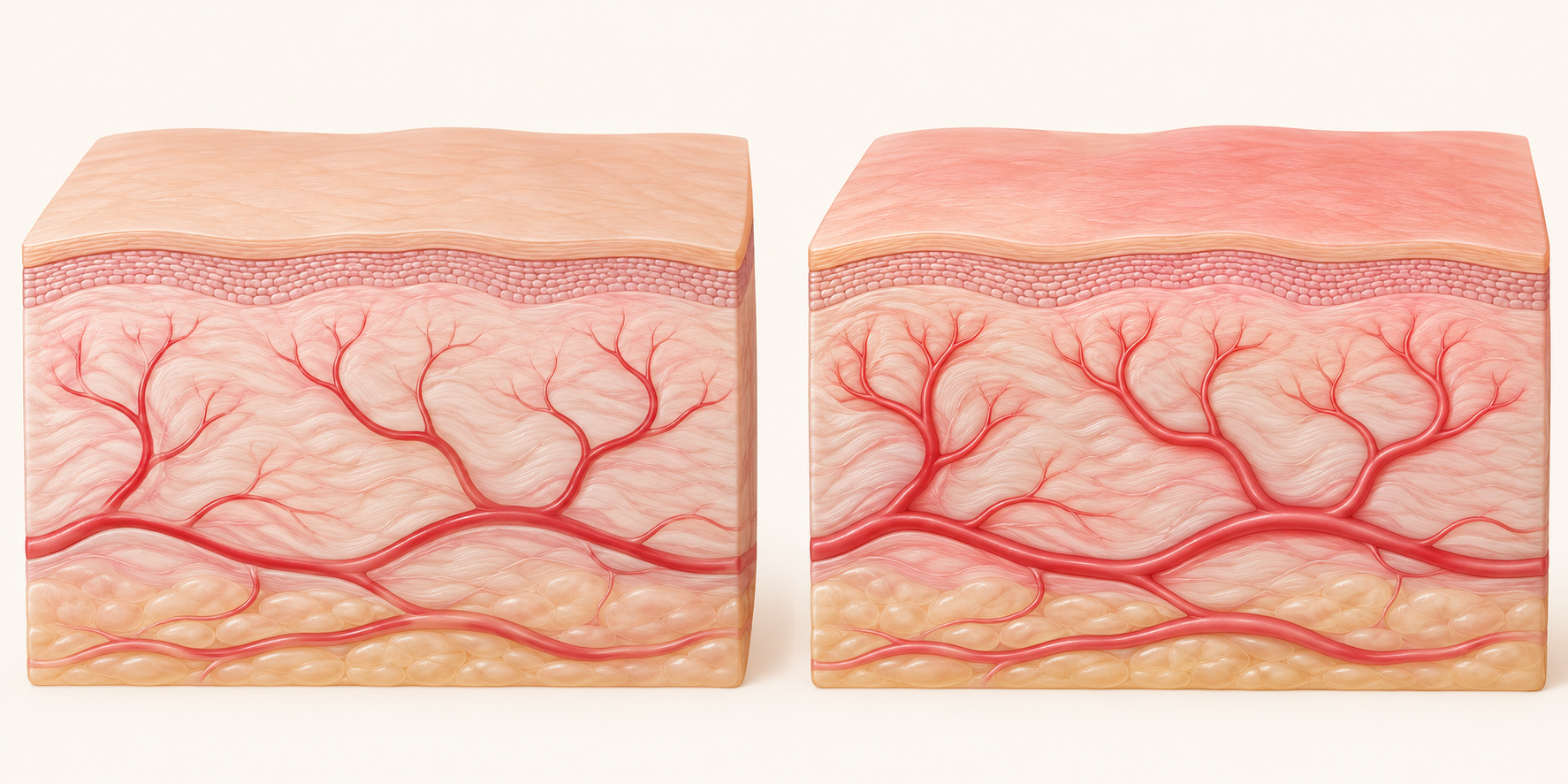
A sauna widens blood vessels in the skin.
Your skin can become warm and flushed in a hot environment.
That is because your body widens blood vessels in the skin and sends more blood towards the surface to release heat. A human sauna study observed this widening of skin blood vessels and changes in skin blood flow. [2]
That raises a reasonable question.
“If more blood is flowing through the area, could the injected toxin be carried away faster and work less well?”
It is a possible explanation, but still a hypothesis.
After injection, botulinum toxin needs to bind to nerve endings and enter them to act. A review also explains that toxin not taken up by nerve endings can enter the circulation. [3]
With that process in mind, it is possible to imagine increased blood flow carrying some toxin away from the injection site before uptake, potentially reducing its effect.
However, the chain “sauna → wider blood vessels → weaker Botox results” has not been directly demonstrated in people by the papers discussed here. More blood flow in the skin does not, by itself, establish that toxin within a muscle is removed faster.
So it would be too definite to say, “Wider blood vessels make Botox less effective.” It is more accurate to describe this as a hypothesis that may help explain caution immediately after treatment.
Bruising and discomfort at the injection site matter too.
Botox is given with a needle. Quite apart from its effect on the muscle, the injection itself can cause reactions such as bruising or pain.
Briefly avoiding hot environments that widen blood vessels is a precaution intended to avoid adding to those reactions.
In a 2023 review, the authors describe advising patients to avoid activities that cause significant vasodilation, such as saunas and hot baths, immediately after treatment. They also point out that much aftercare advice is based on experience and has limited supporting research. [4]
The aim is to limit bruising and discomfort. That does not tell us how much, if at all, avoiding a sauna actually reduces them.
So when should you go back to the sauna?
If Botox was your only treatment, I recommend skipping the sauna that day and putting it off until the following day or later.
A 2022 aesthetic-treatment consensus paper also reports a recommendation to avoid saunas and strenuous exercise until the next day. The paper brings together clinical experience and literature concerning cosmetic treatment with abobotulinumtoxinA. [5]
This does not mean that the toxin becomes unaffected by heat after one day. The timing was not established by a clinical trial comparing different times for returning to the sauna. It is an expert recommendation to take things gently in the immediate period after treatment.
The short explanation “Botox is sensitive to heat” leaves out quite a lot. Rather than worrying that a hot room will instantly erase your results, think of the advice as taking it easy on the day of treatment.
Written by Daebbang (대빵)
References
- Kim HM, et al. Thermal Stability of Botulinum Toxin Type A Formulations Exposed to Heat In Vitro, Assessed by an In Vivo Mouse Potency Bioassay. Aesthetic Surgery Journal Open Forum. 2026;8:ojag025.
- Smolander J, Kolari P. Laser-Doppler and plethysmographic skin blood flow during exercise and during acute heat stress in the sauna. European Journal of Applied Physiology and Occupational Physiology. 1985;54:371–377.
- Hallett M. Explanation of timing of botulinum neurotoxin effects, onset and duration, and clinical ways of influencing them. Toxicon. 2015;107:64–67.
- Johnson AJ, Chen DS. Office-based facial plastics procedures: Neuromodulators. World Journal of Otorhinolaryngology–Head and Neck Surgery. 2023;9:220–226.
- Milotich A, et al. Iberian consensus of good clinical practices in aesthetic treatments with Abobotulinum toxin A. Cirugía Plástica Ibero-Latinoamericana. 2022;48(2):159–170.


Leave a Reply