By Daebbang
“My face turns red even when I get just a little warm. Is it because my skin is sensitive? Should I moisturize more, or consider laser treatment?”
There is more than one reason for a red face. It may be a brief response from your blood vessels, or a sign of inflammation in your skin. That is why redness alone is not enough to decide on a treatment[1].
I recommend first looking at whether the redness comes and goes, whether it is there most of the time, and whether you also have itching, flaking, or bumps. Separating these three patterns can make it clearer which aspects may be helped by skin care and which need a medical assessment.
Why does my face turn red quickly and then settle down?
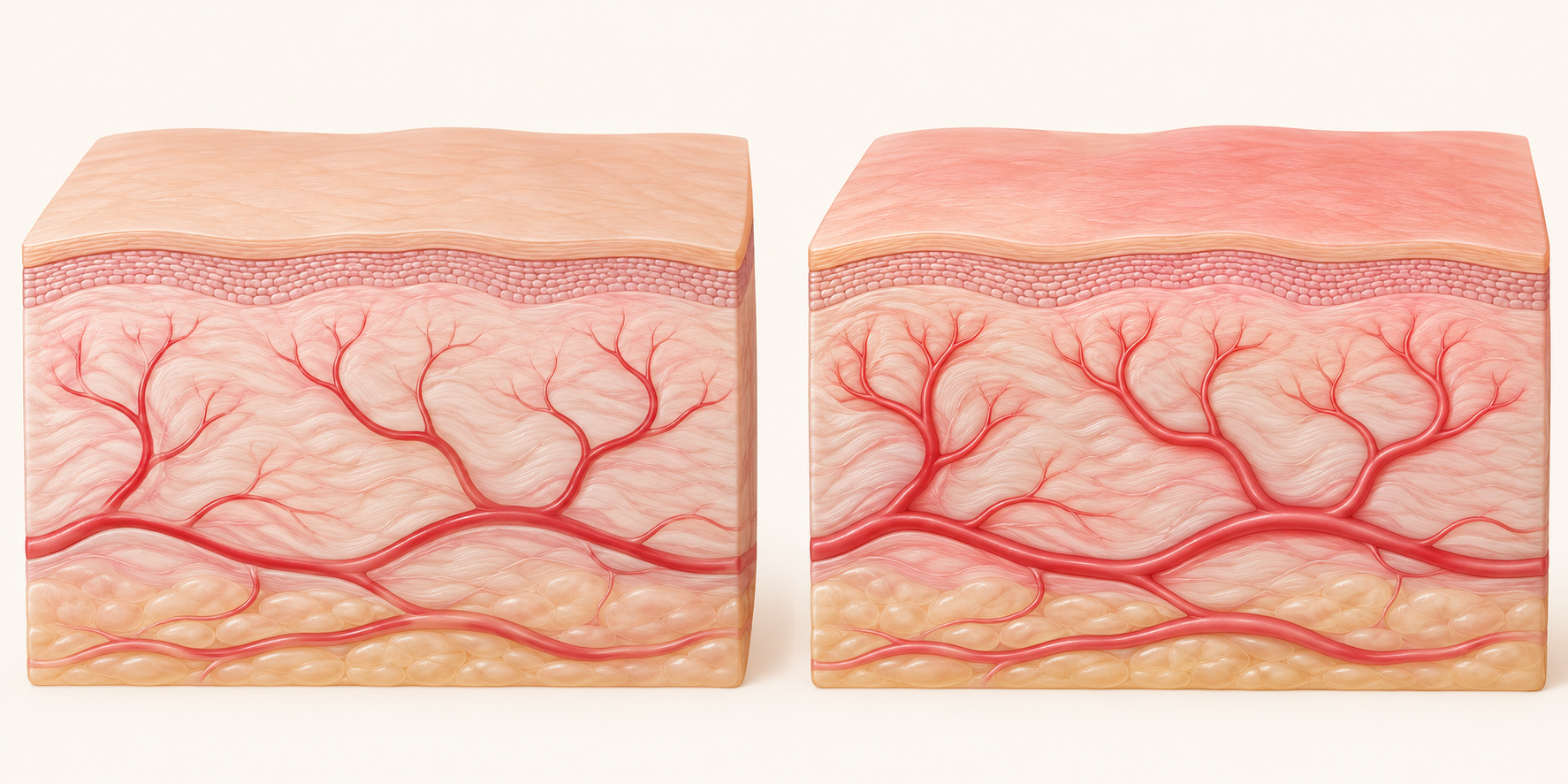
The small blood vessels in your skin do not stay the same width all the time. Think of them as small waterways whose width can change. When the vessels widen and more blood flows through the skin, your face can look redder. A face that feels hot in a warm room or when you are nervous is a familiar example[2, 3].

But saying that the vessels have widened does not fully explain why the redness keeps happening. A face that settles down once the heat has passed needs to be considered differently from redness that stays around the cheeks and nose even without an obvious trigger. Both patterns can occur together in a skin condition called rosacea[4].
So look at your skin between episodes as well as when it is red. Redness may be less visible in some skin tones, making discomfort such as burning or stinging another important clue[4].
Does recurring redness always mean rosacea?
No. Rosacea is a skin condition, not an injection procedure—the two share the word jusa in Korean. It can cause redness that comes back or persists in the center of the face, sometimes with fine visible blood vessels or inflamed bumps that look like acne. Symptoms can also affect the eyes[4].
It helps to think about blood vessels and inflammation together when understanding rosacea. Research suggests that the skin's immune responses and the regulation of nerves and blood vessels are interconnected. Demodex mites, which normally live on the skin, may also contribute to some inflammatory responses, but they cannot explain every red face on their own[5].
Separating causes from triggers can help avoid unnecessary worry. Sunlight, heat, alcohol, hot drinks, and spicy foods can bring out symptoms in some people. Becoming red after eating a particular food does not mean that food is the whole cause of rosacea. Rosacea is not caused by poor hygiene, and it is not contagious[6].
If redness remains around your cheeks and nose between episodes, with recurring burning or bumps, I recommend getting checked for rosacea rather than continually switching products. You do not need to diagnose yourself based on a single symptom.
What should I look for if my skin is also itchy and flaky?
In this situation, consider both what has touched your skin and the possibility of dermatitis. Contact dermatitis, an irritant or allergic reaction to products such as cosmetics, cleansers, or hair dyes, can make the face red and itchy. The timing of a new product can be a clue, but a product you have used for a long time is not automatically ruled out[1].
Other possibilities include seborrheic dermatitis, which can cause greasy-looking or dry flakes over red skin, and eczema such as atopic dermatitis, which causes an itchy, dry rash. In these cases, the dermatitis itself needs to be addressed as well as the redness. Rosacea and dermatitis can overlap, so flaking alone does not establish one diagnosis or the other[1].
Changes beyond your skin can offer clues too. Mention when the redness began if it followed a change in medication or occurs with menopausal hot flushes. Even if you suspect a medicine, it is better to write down its name and when you started taking it and discuss it at your appointment than to stop it on your own[3].
Should treatment start with a cream or a laser?
Start by identifying the symptom that bothers you most and what is causing it. Even within rosacea, inflamed bumps and persistent redness are different treatment targets. Rather than expecting one treatment to improve every symptom equally, it helps to ask what that treatment is intended to reduce[5].
If bumps are the main concern, look at treatments that reduce inflammation
Topical medicines such as ivermectin, metronidazole, and azelaic acid are used for the inflamed bumps of rosacea. Oral medicines may also be used, depending on the condition. Using an antibiotic does not mean rosacea is a contagious bacterial infection; some of these medicines are also used for their anti-inflammatory effects[7, 8].
Studies also distinguish between treatment targets. In two randomized trials involving people with rosacea and at least moderately severe inflammatory bumps, those who used ivermectin cream for 12 weeks had a greater reduction in inflammatory lesions than those who used a comparison cream without the active medicine. This finding cannot simply be applied to every red face that has no bumps[9].
If the bumps improve but the redness remains, it is worth reassessing what treatment the remaining redness needs, rather than concluding that the medicine has failed altogether. Medicine selection should take your skin condition, approval status in South Korea, and local availability into account during a consultation.
If redness and visible vessels are the concern, treatment targets the vessels
Some topical medicines constrict blood vessels to temporarily reduce persistent redness in rosacea. Laser or light treatment that targets blood vessels may be considered for visible vessels or redness. These treatments serve a different purpose from medicines aimed at reducing inflammatory bumps[7].
One example of a vascular laser is the pulsed dye laser (PDL). Intense pulsed light (IPL) uses strong light across a range of wavelengths and is distinct from a laser. A 2024 study assigned 60 people with rosacea characterized mainly by redness and visible vessels to treatment groups using PDL or different IPL settings. Redness-related measures improved from baseline in each group, but follow-up lasted only four weeks after the final treatment. The absence of a statistically clear difference between the devices does not mean that all devices have the same effect or that the effects are permanent[10].
Swelling, bruising, pain, or blisters can occur after treatment. Before choosing a device by name, discuss what is being treated, what changes to expect, and what recovery may involve[10].
If dermatitis is the main problem, treating it is the starting point
For contact dermatitis, identifying and avoiding the responsible substance matters. Seborrheic dermatitis and eczema also need treatment suited to the condition. If you focus only on removing redness when your skin is itchy and flaky, the cause of the discomfort may remain[1].
Do not use leftover steroid ointment on your own to treat facial redness. A clinician may prescribe it for dermatitis when appropriate, but it can worsen rosacea. If you are already using a prescribed treatment, check why it was prescribed and how to use it rather than extending the course or changing it yourself[11].
What should I change at home first?
I recommend starting by simplifying your skin care and keeping track of recurring situations. Changing several products and habits at once makes it harder to work out what is linked to your discomfort.
Use a gentle cleanser and moisturizer, and avoid rubbing your face or using scrubs to remove flakes. If products make your skin sting more, review what you are already using before adding another one. Seek shade, wear a hat, and use a sunscreen your skin tolerates. For skin with rosacea, the American Academy of Dermatology recommends broad-spectrum sunscreen that protects against both UVA and UVB, with SPF 30 or higher[12].
You do not have to restrict all foods and activities automatically. Briefly note when the redness occurs, along with heat, food, alcohol, exercise, and product use at the time. Triggers vary between people, so the aim is to find patterns that repeat for you. Moisturizing and daily care can support treatment, but they do not replace prescription treatment when it is needed[8].
When should I seek medical care promptly?
If redness persists between episodes or recurring flushing interferes with daily life, get the cause checked. At your appointment, it helps to mention when it started, medicines and products you use, and any itching, flaking, bumps, or eye discomfort[3, 7].
Red or gritty-feeling eyes—especially with pain, sensitivity to light, or blurred vision—need prompt medical assessment. Even if the eye symptoms seem unrelated to your skin, they may be associated with rosacea. Do not simply wait while continuing skin care; seek an assessment from a healthcare professional, such as an eye specialist[6].
Let's return to the opening question. If redness comes and goes, look for situations that repeatedly trigger it. If it persists or comes with bumps, itching, or flaking, get the cause checked. Then decide whether the treatment needs to address inflammation, blood vessels, or dermatitis. The starting point for treating facial redness is understanding why your face is red now.
Take-home messages
- Facial redness has several possible causes. Start by noticing whether it is brief or persistent, and what other symptoms occur with it.
- Rosacea is a skin condition that can involve both blood vessel responses and inflammation. Do not assume that a trigger such as food or heat is the sole cause of the condition.
- Inflammatory bumps, persistent redness or visible vessels, and itching or flaking may need different approaches. Identify the treatment target before choosing a medicine or device.
- Start with gentle cleansing, moisturizing, sun protection, and a record of possible triggers. Seek medical care if redness persists or disrupts daily life.
- Mention red or gritty-feeling eyes as well. Pain, sensitivity to light, and blurred vision are particularly important signs that need prompt assessment.
References
[1] American Academy of Dermatology. 10 reasons your face is red.
[2] Oakley A, DermNet. Flushing. 1997.
[3] NHS. Blushing. Reviewed in 2025.
[4] Schaller M et al. Recommendations for rosacea diagnosis, classification and management: update from the global ROSacea COnsensus 2019 panel. British Journal of Dermatology. 2020;182(5):1269–1276. DOI: 10.1111/bjd.18420.
[5] van Zuuren EJ, Arents BWM, van der Linden MMD, Vermeulen S, Fedorowicz Z, Tan J. Rosacea: New Concepts in Classification and Treatment. American Journal of Clinical Dermatology. 2021;22:457–465. DOI: 10.1007/s40257-021-00595-7.
[6] NHS. Rosacea. Reviewed in 2023.
[7] American Academy of Dermatology. Rosacea: Diagnosis and treatment.
[8] NIAMS, NIH. Rosacea: Diagnosis, Treatment, and Steps to Take.
[9] Stein L et al. Efficacy and safety of ivermectin 1% cream in treatment of papulopustular rosacea: results of two randomized, double-blind, vehicle-controlled pivotal studies. Journal of Drugs in Dermatology. 2014;13(3):316–323. PMID: 24595578.
[10] Ruan J, Zheng Y, Cai S. Efficacy and safety comparison between pulsed dye laser and intense pulsed light configured with different wavelength bands in treating erythematotelangiectatic rosacea. Lasers in Medical Science. 2024;39:146. DOI: 10.1007/s10103-024-04098-9.
[11] British Association of Dermatologists. Rosacea.
[12] American Academy of Dermatology. 7 rosacea skin care tips dermatologists recommend. Updated in 2024.


Leave a Reply