By Daebbang
“When I see a white pimple coming up, my hands go to it first. It feels satisfying to squeeze, but I worry about marks later. What is different when a clinic does it?”
The short answer: squeezing pimples at home can be risky, and I do not recommend it. A recent clinical update on acne also lists “do not pick or squeeze” among the basic everyday rules[1]. Several studies report that squeezing is a risk factor that occurs together with acne scarring[1, 2, 3].
Scarring is not the only reason it is risky. It is hard to tell for yourself whether the spot you are about to squeeze in the mirror is a blocked comedone, acne that is already inflamed, or folliculitis, which has a different cause. They can look alike, yet they need different care[1, 4, 5].
That does not mean “one squeeze will certainly leave a scar.” There is still little research that has isolated squeezing and shown directly that it causes scars. In this article, I will separate what has been confirmed from what remains uncertain, and explain why squeezing at home is risky and how clinic extraction differs.
There Are Different Kinds of Acne
Acne is broadly divided into non-inflammatory acne and inflammatory acne[1].
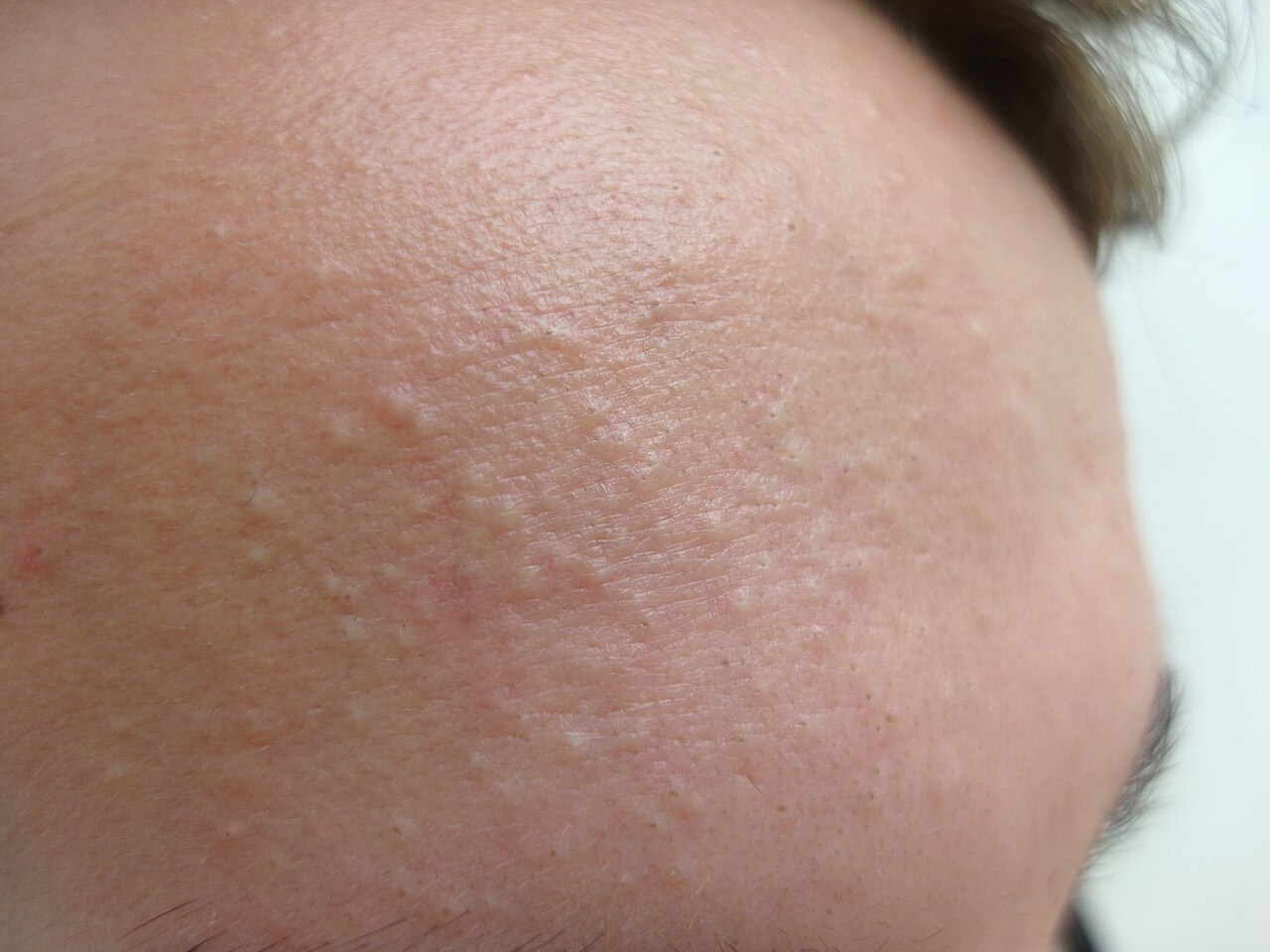
- Non-inflammatory acne (comedones): pores blocked by sebum and dead skin cells. A blackhead is an open comedone whose opening looks dark, and a whitehead is a closed comedone that forms a white bump[1].
- Inflammatory acne: inflammation develops around a blocked pore. This includes red raised papules, pustules in which pus is visible, and deeper, firmer nodules and cysts[1].

This distinction matters because what a clinic extracts is mainly comedones that are not inflamed[1]. In other words, red, painful acne is not something to solve by squeezing.


It May Look Like Acne but Be Folliculitis
Several skin conditions resemble acne, and one of them is folliculitis. The most important clue for telling acne apart is whether comedones, such as blackheads and whiteheads, are also present[1].
Folliculitis is inflammation of the hair follicle, the small pouch from which a hair grows. It appears as small red bumps or pus-filled spots, so it is easily mistaken for acne. It also has more than one cause. It can be caused by bacteria, by an overgrowth of the yeast that normally lives on the skin (Malassezia), or sometimes not by infection at all. Visible pus does not always mean a bacterial infection[4]. Folliculitis caused by yeast shows up as itchy red bumps and pustules, and a dermatology expert position statement recommends confirming the cause before starting treatment[5].

Because the treatment of folliculitis depends on its cause, squeezing cannot address that cause[4, 5]. To learn how to tell acne and folliculitis apart, please also read Acne or Folliculitis? How Can You Tell Similar-Looking Bumps Apart?
Why Do People Worry About Scars from Squeezing?
The risk of acne scarring is said to be related to how severe the acne was, how long it went uncontrolled, and picking or squeezing[1].
An acne scar risk assessment tool created by experts after reviewing the literature lists the habit of manipulating acne with your hands as one of four risk factors, alongside the worst severity of acne, the duration of acne, and family history[2]. In a survey of 225 adult acne patients in Thailand, picking and squeezing habits also emerged as a factor associated with scarring, together with acne severity[3].
However, such studies show tendencies that occur together. It is hard to fully separate the fact that people with severe acne touch it more often from the fact that severe acne itself tends to leave scars. So rather than fearing that “squeezing always means a scar,” it is better to understand it as a habit that may raise scar risk, so it is better to cut back.
Marks should be considered too. After acne clears, darkened post-inflammatory hyperpigmentation can remain, and it can be more noticeable and last longer in darker skin tones[1]. A review of adult female acne explains that picking at the skin can increase the risk of secondary infection, scarring, and pigmentation[6]. For why dark marks appear and how long they last, see Dark Patches After Laser Treatment: Why Does Post-Inflammatory Hyperpigmentation Happen, and How Long Does It Last?
Why Squeezing at Home Is Risky
None of the guidelines I reviewed this time recommends a method for squeezing safely at home. So instead of a standard that says “you may squeeze if you do it this way,” I will explain why and when touching it at home is risky.
- It is hard to know what it is in the first place: whether it is a comedone, inflammatory acne, or folliculitis is easy to confuse by appearance alone, and in a clinic the cause is confirmed with tests when needed[1, 4, 5].
- Red, swollen, painful acne: even in the clinic, extraction is aimed mainly at comedones without inflammation[1].
- Large, deep, firm acne (nodules and cysts): guidelines recommend that a doctor add an injection that calms inflammation (an intralesional corticosteroid injection) for these large lesions[7]. They are not something to solve by squeezing.
- A family history of scarring, or skin that easily keeps dark marks: if scar or mark risk factors are already present, it is better not to touch it[1, 2].
- You want to stop but your hands keep going to it: I will talk about this separately below.
There are things you can do instead of touching. Wash gently once or twice a day with a mild cleanser, and avoid grainy scrubs and over-washing. To reduce dark marks, it is good to apply a sunscreen that does not clog pores during the day[1].
How Is Clinic Extraction Different?
Clinic extraction is a procedure that uses a tool such as a comedone extractor to remove open and closed comedones directly. Satisfaction tends to be high because the improvement is visible right away, but it is described as an adjunct treatment for acne that is mainly non-inflamed comedones, and it should be done by a clinician experienced in the procedure[1].
There is a reason it is called an adjunct treatment. Acne is treated as a chronic disease that often recurs[1]. Unlike removing comedones that have already formed, a topical retinoid reduces the formation of new comedones in the first place[1]. That is why the main treatments strongly recommended in the guidelines are topical medicines such as retinoids and benzoyl peroxide, with oral medicines added if needed[1, 7]. Extraction is closer to a tool used together with these treatments.
There are also remarks that the effect of extraction does not last long and that it can be irritating. In a study of patients with dense comedones that compared different treatments on each half of the face, comedones decreased after four extractions at two-week intervals, but the laser compared alongside it reduced them more[8]. Because it was a single-center study, it is not evidence that laser is generally better, but it is worth noting that extraction is not a one-time treatment but an adjunct that needs repeating.
If It Is Hard to Stop Squeezing
Some people cannot resist and keep picking whenever they see a pimple. This is classified in mental health diagnostic manuals as excoriation (skin-picking) disorder, and it is noted that it is easily overlooked in young patients with repeated acne marks and scars[9]. In a small randomized study of 32 adults, adding cognitive behavioral therapy for 2 months to acne medicine improved both picking behavior and skin condition[10].
It may not be a matter of willpower but a problem you can get help with. If your hands keep going to it, please tell your dermatologist honestly.
A Pimple You Want to Squeeze: When Is a Good Time to See a Doctor?
If pimples you want to squeeze keep appearing, it is time to think about seeing a doctor rather than squeezing at home. At a clinic, comedones are removed with sterilized tools, and large, painful pimples are treated with an injection or by draining the pus instead of squeezing[1, 11]. In particular, in the situations below, do not touch it at home and see a doctor.
- When there are many white or black clogged comedones and you keep wanting to squeeze them: At a clinic, extraction can remove comedones with sterilized tools[11]. Extraction is usually an adjunct rather than a first treatment, so it is best planned together with a topical medicine that reduces new comedones[1, 11].
- When a pimple you want to squeeze is red, swollen and painful, or feels deep and firm: Squeezing can push the contents deeper into the skin and make the inflammation worse[11]. If there are several of these or they do not settle down, see a doctor. For large pimples, a doctor can give an injection to calm the inflammation or drain the pus[7, 11, 12].
- When the squeezed spot becomes more and more red, hot, swollen and painful: Squeezing it yourself can let bacteria from your hands in and cause an infection[11]. Skin that is painful, hot and swollen can be a sign of cellulitis, a bacterial infection that has spread deep into the skin, so you should see a doctor quickly, and even more urgently if the swelling spreads around the eye. If you have a high fever, feel dizzy or become confused, go to the emergency room right away[13].
- When pus-filled bumps appear around hairs without any comedones: It may be folliculitis rather than acne[1]. The treatment of folliculitis depends on the cause, such as bacteria or yeast, so identifying the cause comes first[4, 5, 14].
- When pitted scars start to remain at the squeezed spot: The risk of scarring rises the longer acne stays uncontrolled and with picking or squeezing[1]. If scars have started to form, it is better not to put it off[1]. We have covered the dark marks that remain after squeezing separately in Dark Patches After Laser Treatment: Why Does Post-Inflammatory Hyperpigmentation Happen, and How Long Does It Last?.
- When it is hard to stop the squeezing habit on your own: This may be a problem you can get help with[9, 10].
Even if you are trying acne products at home, if you notice signs like these, do not wait for them to work. See a doctor.
Take-home messages
- Squeezing pimples at home can be risky, and I do not recommend it. Several studies report that squeezing is a risk factor that occurs together with acne scarring.
- It is hard to tell at home whether the spot is a comedone, inflammatory acne, or folliculitis. The treatment of folliculitis depends on its cause, so squeezing does not solve it.
- It has not been proven that squeezing always leaves a scar. Still, it is a habit that may raise scar risk along with acne severity and duration, so it is better to cut back.
- Red, painful, or deep, firm acne is not something to solve by squeezing. For large lesions, there are other options, such as injection treatment by a doctor.
- Clinic extraction is an adjunct treatment for non-inflamed comedones. The main treatment is a topical medicine that reduces new comedones, with oral medicine added if needed.
- If you find it hard to stop squeezing, tell your doctor at your visit rather than trying to cope alone. It may be a problem you can get help with.
References
[1] Iyengar L, Welsh B. Acne vulgaris: a clinical update. Australian Prescriber. 2026;49(4):138–144. DOI: 10.18773/austprescr.2026.029
[2] Tan J, Thiboutot D, Gollnick H, Kang S, Layton A, Leyden JJ, Torres V, Guillemot J, Dréno B. Development of an atrophic acne scar risk assessment tool. Journal of the European Academy of Dermatology and Venereology. 2017;31(9):1547–1554. DOI: 10.1111/jdv.14325
[3] Yan C, Phinyo P, Yogya Y, Chuamanochan M, Wanitphakdeedecha R. Risk Factors Associated With Facial Acne Scarring in Thai Patients With Acne: A Cross-Sectional Study. Journal of Cosmetic Dermatology. 2025;24(1):e16695. DOI: 10.1111/jocd.16695
[4] Luelmo-Aguilar J, Santandreu MS. Folliculitis: recognition and management. American Journal of Clinical Dermatology. 2004;5(5):301–310. DOI: 10.2165/00128071-200405050-00003
[5] Henning MAS, Hay R, Rodriguez-Cerdeira C, et al. Position statement: Recommendations on the diagnosis and treatment of Malassezia folliculitis. Journal of the European Academy of Dermatology and Venereology. 2023;37(7):1268–1275. DOI: 10.1111/jdv.18982
[6] Dréno B, Bagatin E, Blume-Peytavi U, Rocha M, Gollnick H. Female type of adult acne: Physiological and psychological considerations and management. Journal der Deutschen Dermatologischen Gesellschaft. 2018;16(10):1185–1194. DOI: 10.1111/ddg.13664
[7] Reynolds RV, Yeung H, Cheng CE, et al. Guidelines of care for the management of acne vulgaris. Journal of the American Academy of Dermatology. 2024;90(5):1006.e1–1006.e30. DOI: 10.1016/j.jaad.2023.12.017
[8] Yang MY, Qiao SM, Ning DC, Ding YH, Zeng WH, Wang Z. Treatment effect of ultra-pulse dynamic CO2 laser and comedone extractor in dense comedones: a prospective, randomized, split-face, evaluator-blind, controlled clinical trial. Lasers in Medical Science. 2024;39(1):233. DOI: 10.1007/s10103-024-04104-0
[9] Ekore RI, Ekore JO. Excoriation (skin-picking) disorder among adolescents and young adults with acne-induced postinflammatory hyperpigmentation and scars. International Journal of Dermatology. 2021;60(12):1488–1493. DOI: 10.1111/ijd.15587
[10] Mashayekhi Goyonlo V, Sardabi MS, Tavalaei AM, Khoshnevisan Z, Razmara M. Cognitive behavioral therapy as an adjuvant therapy in acne excoriée: a randomized controlled clinical trial. Journal of Dermatological Treatment. 2022;33(2):782–788. DOI: 10.1080/09546634.2020.1776207
[11] American Academy of Dermatology. Pimple popping: Why only a dermatologist should do it. Updated October 2023. aad.org
[12] American Academy of Dermatology. Tips to treat a deep, painful pimple. Updated October 2023. aad.org
[13] NHS. Cellulitis. Reviewed April 2024. nhs.uk
[14] American Academy of Dermatology. Acne-like breakouts could be folliculitis. aad.org


Leave a Reply