By Daebbang
“I have little bumps on my forehead. Should I use an acne treatment?”
“The pimples on my back keep itching. Is this back acne too?”
Not every red bump is acne. If blackheads and whiteheads are also present, think of acne; if clusters of similarly sized, itchy bumps appear, folliculitis is another possibility to consider. That second pattern can occur with Malassezia folliculitis. [1] [2]
Why does the distinction matter? Similar-looking bumps may need different treatments. Before squeezing them or reaching for an ointment, let’s look at what is happening beneath the skin.
Where do acne and folliculitis develop?
Both involve the places where hairs grow. Even when facial hair is barely visible, the tiny structures that grow fine hairs are still there.
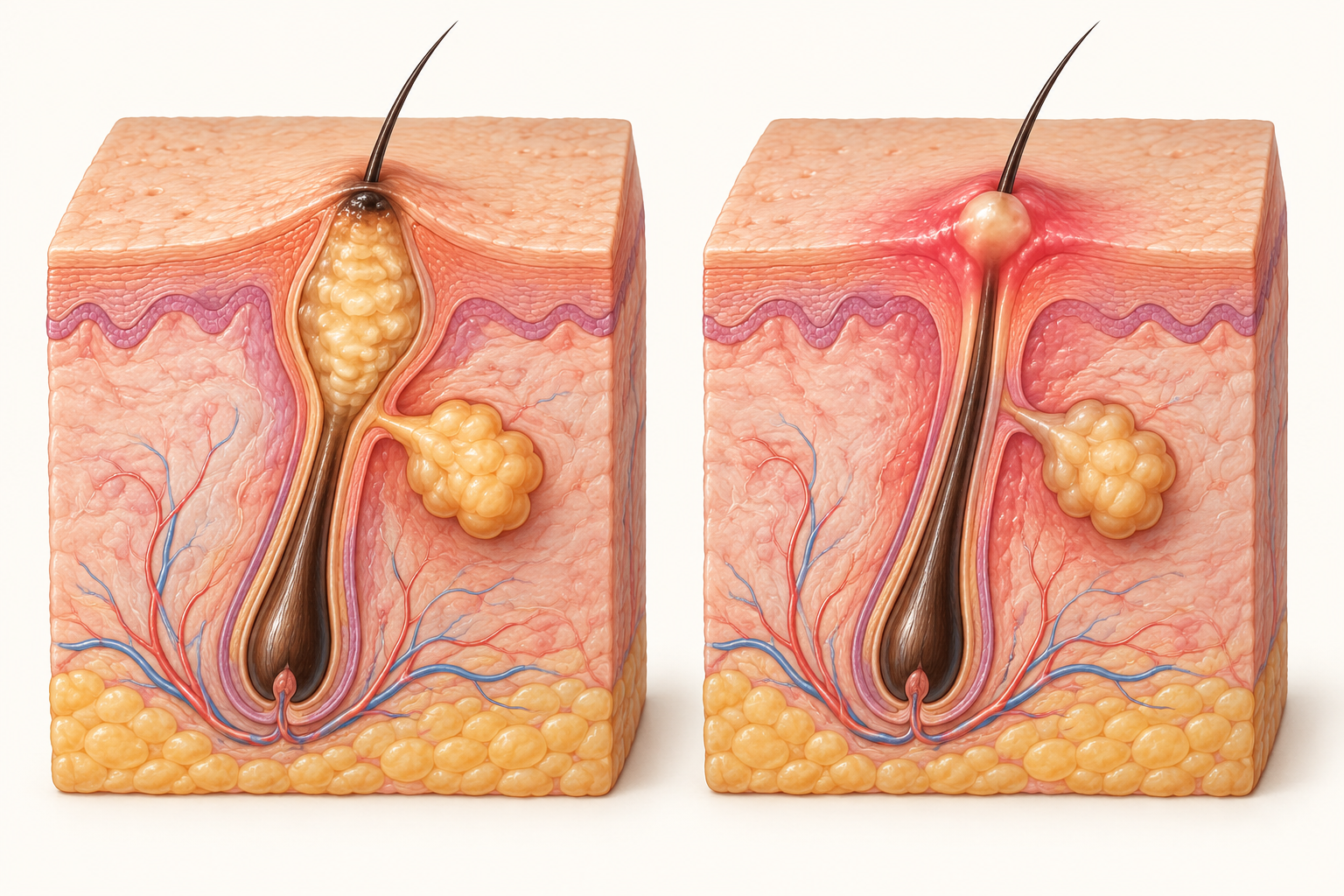
The small pocket surrounding a hair beneath the skin is called a hair follicle. Attached to its side is a sebaceous gland, which makes the skin’s oil, or sebum. Think of it as a little home for a hair with an oil gland attached.
Acne develops through a combination of factors, including blockage by sebum and dead skin cells, oil production, skin microbes, and inflammation. Folliculitis literally means inflammation of a hair follicle. Bacteria or a yeast called Malassezia may be involved, but irritation without an infection can also cause folliculitis. [1] [3]

What should you look for in the mirror?
Look together at whether there are plugged bumps, whether the bumps vary in appearance, and how itchy they are. Here is a comparison of three commonly confused conditions.
| Condition | Visible clues | Treatment approach |
|---|---|---|
| Acne | A mix of blackheads, whiteheads, red pimples, and other types of bumps | Address both clogged pores and inflammation |
| Bacterial folliculitis | Red bumps or pustules centered on hairs; they may sting or hurt | Reduce irritation and assess the need for antibacterial treatment based on extent and depth |
| Malassezia folliculitis | Multiple small bumps of similar size, often itchy, on areas such as the forehead, hairline, chest, or back | Antifungal treatment is central once the diagnosis is established |
This table offers diagnostic clues. Acne and folliculitis can coexist, so do not treat it as a quiz in which one feature lets you pick one condition and rule out the other. [1] [2] [4] [5]
If there is a white spot, doesn’t that mean acne?
A whitehead is different from pus. This is a common source of confusion.
A whitehead is a closed comedone: a small raised bump caused by sebum and dead skin cells accumulating inside a pore. A blackhead is an open comedone. By contrast, the yellow or white material at the tip of a red, swollen bump may be pus.
Both acne and folliculitis can produce pus. So “Are there comedones too?” is a more useful question than “Can I see something white?” You do not need to squeeze a bump to find out. [1]
Does itching mean a fungus is to blame?
Itching is a clue, not proof of a fungal infection.
Malassezia is a yeast—a type of fungus—that normally lives on our skin. Under certain conditions, it can multiply within follicles and cause inflammation. Heat, sweating, and conditions that trap moisture and cover the skin are associated factors. Recent antibiotic use is also worth mentioning during a medical visit.
But bacterial folliculitis and other forms of dermatitis can itch too. Hearing the word “folliculitis” does not mean every case should be treated with an antifungal, or, conversely, with an antibiotic ointment. Antifungals target fungi, while antibiotics target bacteria. [2] [5]
During an assessment, the appearance and distribution of the bumps are considered alongside the medicines you have used. When needed, examining material from a lesion under a microscope or testing for bacteria can help narrow down the cause. Not everyone needs testing. [2] [3]
What should you do at home first?
When the cause is unclear, I recommend reducing irritation before layering on several ointments.
- Do not squeeze or scratch. Avoid pressing bumps to inspect what is inside or trying to scrub them away.
- Cleanse gently. Washing until the skin feels squeaky-clean does not solve the underlying cause. If your skin feels tight, use a gentle moisturizer that is unlikely to clog pores.
- Reduce sweat and friction. Gently wash off sweat after exercise and change out of damp clothing. If bumps keep appearing in shaved areas, reduce very close shaving and frequent hair removal.
- Do not repeatedly use leftover antibiotic or steroid ointments on your own. If you are using prescribed medication, tell the prescribing clinician about new-looking bumps and itching rather than changing the treatment yourself.
These are basic steps to reduce irritation. They do not replace acne treatment or treatment directed at the cause of folliculitis. [1] [2] [5]
If an acne treatment is not working, does that mean folliculitis?
A lack of improvement after just a few days does not, by itself, mean you have folliculitis. Topical acne treatment can take around 6–8 weeks to produce noticeable improvement. Follow the prescribed treatment and review your progress at the planned follow-up. [6]
On the other hand, if clusters of itchy bumps that look different from before appear during treatment, or bumps repeatedly develop pus, that is a reason to reconsider the diagnosis before simply continuing medication for longer. In particular, Malassezia folliculitis needs antifungal treatment; using more antibiotics is not the solution. [2]
Seek medical care the same day if redness spreads rapidly, pain and swelling are severe, or a fever develops. Recurrent deep, painful lumps or scarring are also reasons not to rely on home care alone. [7] [6]
My recommended starting point is simple: for recurring bumps mixed with comedones, focus on acne treatment; for similarly sized, itchy bumps, first have folliculitis considered. Bringing photographs and a list of the medicines and skin care products you use can help explain what has changed. The priority is to find the right treatment approach, rather than squeezing bumps to guess their name.
Take-home messages
- Distinguish whiteheads from pus. The presence of comedones is an important clue when assessing acne.
- Consider folliculitis when similarly sized, itchy bumps keep recurring. Do not assume a fungus is responsible based on itching alone.
- Folliculitis medication depends on the cause. Do not switch between antibiotics, antifungals, and steroids on your own.
- Do not give up on acne treatment after only a few days. But a new pattern of rash, rapidly spreading redness, severe pain, or fever should be assessed without waiting.
References
- Leung AKC, et al. Dermatology: how to manage acne vulgaris. Drugs in Context. 2021. doi:10.7573/dic.2021-8-6.
- Henning MAS, et al. Position statement: Recommendations on the diagnosis and treatment of Malassezia folliculitis. J Eur Acad Dermatol Venereol. 2023. doi:10.1111/jdv.18982.
- Luelmo-Aguilar J, Sàbat Santandreu M. Folliculitis: recognition and management. Am J Clin Dermatol. 2004. doi:10.2165/00128071-200405050-00003.
- Prindaville B, et al. Pityrosporum folliculitis: A retrospective review of 110 cases. J Am Acad Dermatol. 2018. doi:10.1016/j.jaad.2017.11.022.
- Laureano AC, Schwartz RA, Cohen PJ. Facial bacterial infections: folliculitis. Clin Dermatol. 2014. doi:10.1016/j.clindermatol.2014.02.009.
- Santer M, Burden-Teh E, Ravenscroft J. Managing acne vulgaris: an update. Drug Ther Bull. 2024. doi:10.1136/dtb.2023.000051.
- Stevens DL, et al. Practice guidelines for the diagnosis and management of skin and soft tissue infections: 2014 update by the Infectious Diseases Society of America. Clin Infect Dis. 2014. doi:10.1093/cid/ciu296.


Leave a Reply