
“I apply plenty of cream, but my face starts feeling tight soon after washing. Should I switch to a more expensive moisturizer?”
Before spending more, I recommend making cleansing gentler and moisturizing in a way that helps keep water from escaping. If you already have a moisturizer that suits your skin, there is no need to replace it simply with a more expensive one.
Today, we are talking about everyday facial dryness and tightness, rather than caring for a wound immediately after laser treatment.
Why does my skin still feel tight after applying cream?
Applying a lot of cream and helping your skin retain moisture are not the same thing.
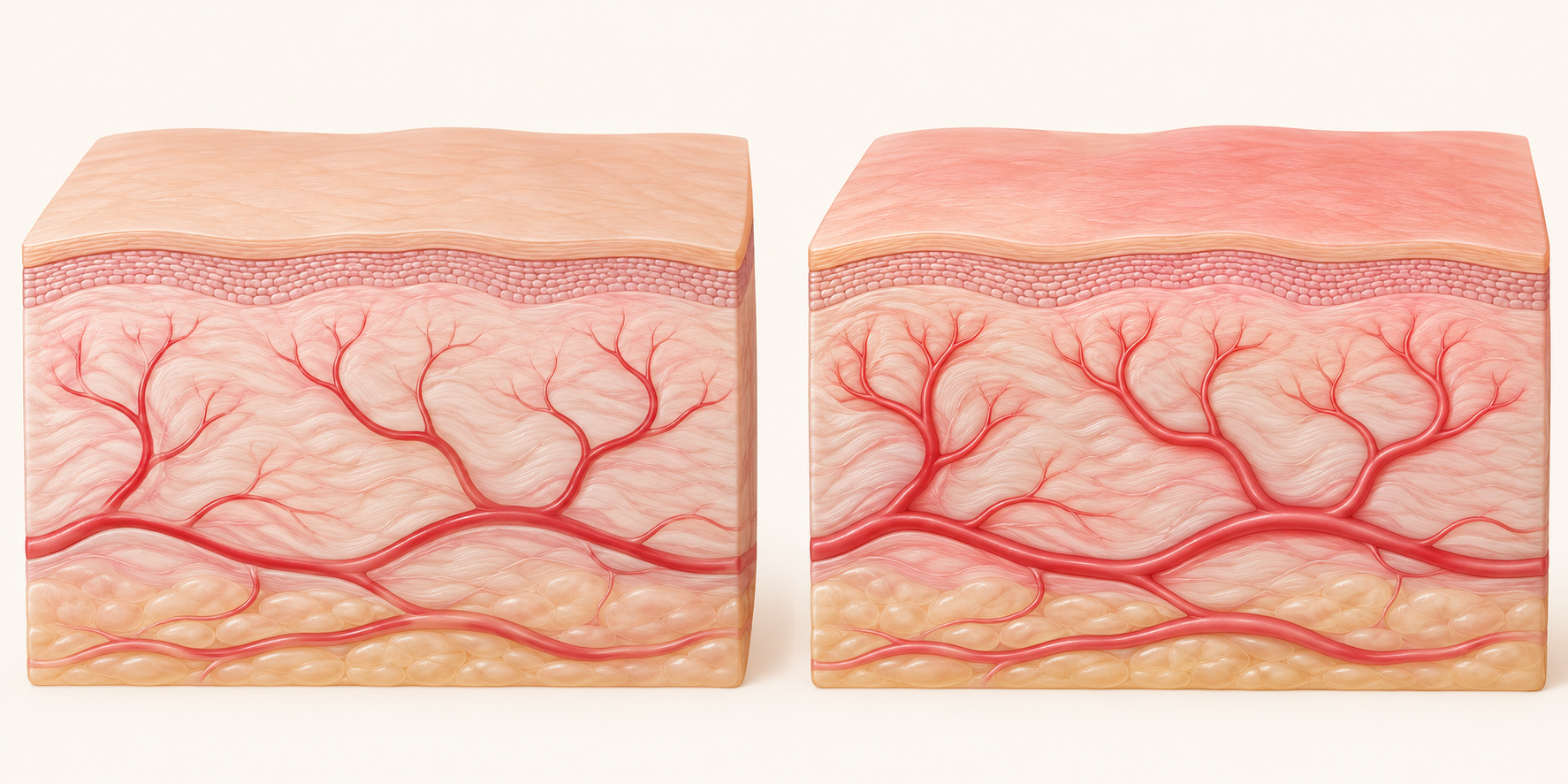
The outermost part of the skin is a thin layer called the stratum corneum. Think of its skin cells as bricks and the lipids between them as the material filling the gaps. This layer helps prevent excessive water loss.
When the stratum corneum loses moisture, it becomes stiffer, which can contribute to a feeling of tightness. Experiments have also shown that cleansers can affect the tension that develops as this layer dries. However, a tight feeling alone does not prove that your skin barrier is damaged. [1]
If you wash for a long time with hot water or repeatedly cleanse until your skin feels squeaky clean, then compensate by applying lots of cream, it is worth changing your cleansing routine first.

Is adding moisture different from keeping it in?
Moisturizers help hold water in the skin and reduce the amount that escapes. Grouping some common ingredients by their roles makes this easier to understand.
| Role | Examples | In plain language |
|---|---|---|
| Holding water | Glycerin and similar ingredients | Help retain water in the stratum corneum. |
| Reducing water loss | Petrolatum, dimethicone and similar ingredients | Form a surface film that helps reduce water escaping. |
| Supplementing skin lipids | Ceramides, cholesterol, fatty acids and similar ingredients | Are used to supplement lipids that make up the skin barrier. |
In a study of 51 people with dry skin, moisturizers were applied to the forearms and assessed over 12 hours. The results showed complementary roles for glycerin in retaining moisture and petrolatum in reducing water loss. [2]
So, if your skin soon feels tight again after a lightweight hydrating serum or gel, I recommend trying a cream moisturizer that helps reduce water loss before adding more and more layers of products. On the other hand, if your current lotion keeps your skin comfortable throughout the day, there is no reason to make your routine heavier.
Do not choose a product solely because the label says it contains ceramides. Some finished products containing ceramides have improved skin-barrier measurements, but those results reflect multiple ingredients and the formulation working together. One ingredient name does not guarantee how every product will perform. [3]
Does that mean an expensive moisturizer is not necessarily better?
A higher price does not automatically mean better moisturization for your skin. Before looking at the price tag, I recommend checking whether the product relieves tightness, avoids stinging or itching, and is something you can use consistently.
In a three-week study involving 39 children with atopic dermatitis, two prescription barrier creams did not show better clinical outcomes than an over-the-counter petrolatum-based moisturizing ointment. The ointment studied was a combination formulation, not pure petroleum jelly. [4]
This small study in children cannot tell us that all facial creams for adults work the same way. Still, it offers a useful reminder that there is no need to start by paying more just because you assume an expensive product must work better.
If a reasonably priced product reduces tightness without discomfort, keep using it. I recommend using enough of a product that suits your skin consistently, rather than rationing tiny amounts of an expensive cream.
How should I start moisturizing today?
Start with gentler cleansing and consistent moisturizing.
First, cut back on hot water and repeated cleansing. Wash gently with lukewarm water, then pat rather than rub your skin dry with a towel. In an experiment involving water immersion of healthy participants’ hands, hot-water exposure produced greater water loss and redness. The study did not establish an exact temperature or duration for washing the face, but it supports avoiding prolonged washing with hot water. [5]
Second, gently pat off excess water after washing and apply moisturizer. It is a useful habit to apply it while the skin is still slightly damp. But you do not need to rush as though it becomes pointless after three minutes. A study of 60 healthy young adults found no significant difference in changes in moisturizing measurements between applying moisturizer immediately after cleansing and applying it 30 minutes later. Even if your skin has already dried, go ahead and moisturize. [6]
Third, start in the morning and evening, then reapply where needed. This is a practical starting routine, not a proven optimal frequency for every skin type. If your cheeks feel tight during the day, add moisturizer there. If lotion is not enough, try a cream.
There is no need to replace your toner, essence, ampoule and cream all at once. Changing one thing at a time makes it easier to tell what feels comfortable and what causes irritation.
What if moisturizer stings and my skin stays red?
If tightness is accompanied by persistent redness, itching or burning, look into dermatitis or product irritation before layering on more cream.
If cosmetic retinol, acid exfoliants or scrubs have made your skin uncomfortable, take a break from them and simplify your routine to cleansing and moisturizing. For prescribed treatments, it is better to discuss how often and how to use them with your clinician rather than stopping them on your own.
You do not need to keep tolerating a product that stings every time you apply it on the assumption that this is “part of repairing the barrier.” Stop using that product, and seek medical assessment if symptoms persist or worsen despite a simpler routine. Stinging alone does not establish an allergy, but the skin may need something different from routine dry-skin care. [Dermatology society guidance]
If your skin still feels tight after moisturizer, start by changing your cleansing habits and the type of moisturizer, rather than the price tag. Once you find a product that suits your skin, using it consistently comes first.
References
- German GK et al. Surfactant treatments influence drying mechanics in human stratum corneum. J Biomech. 2013. View paper
- Vaillant L et al. Combined effects of glycerol and petrolatum in an emollient cream: A randomized, double-blind, crossover study in healthy volunteers with dry skin. J Cosmet Dermatol. 2020. View paper
- Danby SG et al. Enhancement of stratum corneum lipid structure improves skin barrier function and protects against irritation in adults with dry, eczema-prone skin. Br J Dermatol. 2022. View paper
- Miller DW et al. An over-the-counter moisturizer is as clinically effective as, and more cost-effective than, prescription barrier creams… J Drugs Dermatol. 2011. View paper
- Impact of Water Exposure and Temperature Changes on Skin Barrier Function. J Clin Med. 2022. View paper
- Nguyen et al. Moisturizing effectiveness of immediate compared with delayed moisturization. J Cosmet Dermatol. 2022. View paper


Leave a Reply