한국어 · English · 简体中文 · 繁體中文 · 日本語
“I’ve been having pico toning regularly, but the spots I wanted to fade are still there.”
Before deciding how many more sessions to book, there is something to check first: what kind of pigmentation you want to fade, and whether your treatment matches it.
You may have noticed clinics offering separate packages for toning and for treating freckles or sun spots. Sometimes they even use the same picosecond laser. So why are these offered separately?
How is toning different from targeted treatment for dark spots?
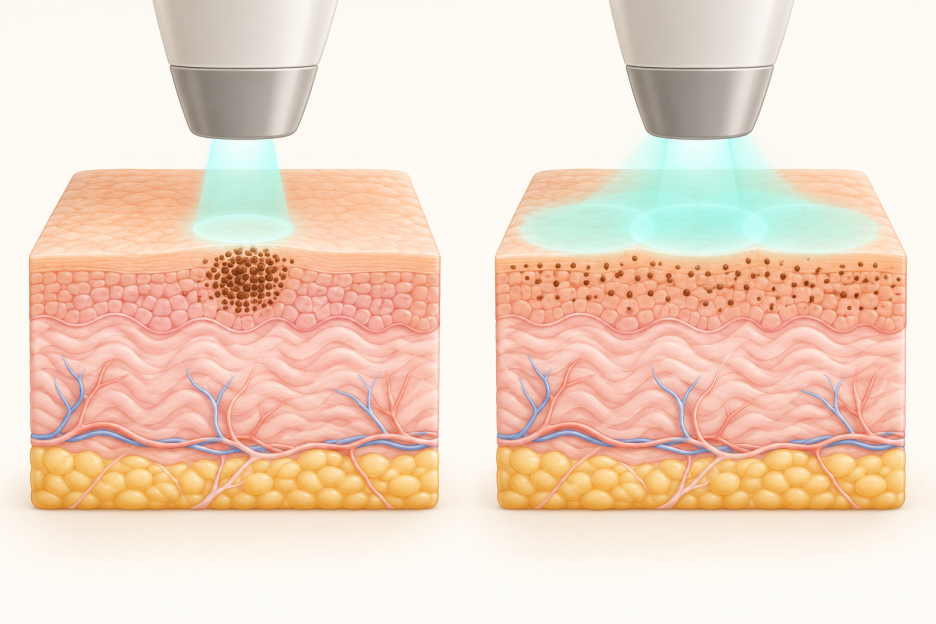
Simply put, toning aims to make the overall complexion look clearer and more even, while gradually fading scattered pigmentation. Think of it as a gradual approach to improving the overall appearance of skin that looks dull or uneven because of pigmentation. [Study of facial pigmentation]
But making the whole face look a little clearer and fading one particularly noticeable freckle or sun spot to the extent you want can be different treatment goals.
Toning is itself a type of pigmentation treatment. When clinics list it separately, though, they usually mean a distinction like this:
Swipe or scroll sideways to read the full table.
| Approach | Main goal | How it is performed |
|---|---|---|
| Nano or pico toning | A clearer, more even complexion and gradual fading of scattered pigmentation | Repeated treatment over a broad area at a relatively low energy density |
| Targeted treatment for freckles or sun spots | Fading individual, noticeable brown spots | Treating each lesion with a wavelength, energy and delivery method suited to its type |
For example, a study treating solar lentigines—often called sun spots—used a 532 nm laser aimed at individual lesions. That is a different treatment setup from the 1064 nm toning studied over broader areas of the face. [Sun spot treatment study] [Toning comparison study]
Using the same machine does not mean receiving the same treatment.
Package names and what they include vary between clinics, so it helps to check what treatment you will actually receive, rather than relying on its name alone.

Are the spots on my face melasma, freckles or sun spots?
“I’m not sure whether I have melasma, freckles or sun spots.”
That is understandable. We often call anything brown on the face a “dark spot,” but these marks can be different types of lesions.
Before choosing a laser, identify the pigmentation you want to fade. Its appearance is one clue, but we also look at where it is, when it appeared and how it changes with sun exposure.
Swipe or scroll sideways to read the full table.
| Type | Clues that help tell them apart |
|---|---|
| Melasma | Often appears as relatively broad brown patches on both cheekbones or cheeks, the forehead or around the upper lip. It may start in adulthood and can become darker with sun exposure or pregnancy. |
| Freckles | Often look like small brown spots scattered over the nose and cheeks. Clues include their presence since childhood, becoming more noticeable in sunny summers and fading in winter. |
| Solar lentigines (sun spots) | Brown spots on sun-exposed areas such as the face and the backs of the hands. They tend to become more numerous with age and accumulated sun exposure. Unlike freckles that can fade seasonally, they often persist. Their sizes vary. |
Here, “sun spots” refers to solar lentigines, which are associated with sun exposure. These features are clues, not a way to confirm a diagnosis from one feature alone. [Study of facial pigmented lesion identification] [Study of freckles and solar lentigines] [Clinical identification of freckles]
The reference photos below come from different sources. Skin tones and photographic conditions differ, so look at the shape and distribution of the marks, rather than comparing how dark they look between photos.

Photo: Dr.Gandikota Raghurama Rao / Wikimedia Commons · CC BY 4.0 · Used as supplied, without alteration.

Photo: Loyna / Wikimedia Commons · CC BY-SA 2.5 · Used as supplied, without alteration.

Photo: Alain Gérard / Wikimedia Commons · CC BY-SA 4.0 · Used as supplied, without alteration.
Melasma, freckles and sun spots can coexist on the same face. This is why broader pigmentation and individual, noticeable spots may be treated separately, even on one person. [Study of melasma alongside other pigmented lesions]
Rather than deciding what you have from photos alone, point out the areas you want to fade during your consultation. A spot that has recently grown or changed in color or shape should be examined before you have laser treatment. [Why identification matters before laser treatment]
What does toning do in the skin?
The skin contains tiny structures called melanosomes, which hold melanin pigment. Nano and pico pigment toning use short laser pulses to act on this pigment, aiming to fade it while limiting damage to the surrounding skin.
A study examining skin under the microscope after nano toning found fewer melanin granules while cellular structures were relatively preserved. [Microscopic study of toning]
This approach can help when toning is appropriate for the pigmentation being treated. But “low intensity” does not mean that unlimited sessions are a good idea. Treatment needs to be adjusted to the skin’s response.
Nano versus pico: what difference might you notice?
Nano and pico refer to the duration of each pulse of laser light. When we say pico is shorter, we do not mean that treating the whole face takes less time. We mean that each individual burst of light lasts for a shorter moment.
Delivering energy in such a brief moment can concentrate energy in the pigment while reducing the time available for heat to spread into the surrounding area.
Acting on pigment while limiting the thermal burden on surrounding skin is an advantage of pico pulses. But picosecond lasers still have thermal effects, and the actual skin response depends on the intensity and delivery method. [Study of pulse duration and pigment response]
Nanosecond lasers also use short pulses that can selectively target pigment. It would be misleading to think that “nano burns the surrounding skin, whereas pico only breaks up pigment.” [Microscopic study of nano toning]
Does that mean dark spots fade better?
Some studies of targeted freckle or sun spot treatment found better fading with pico. But the difference was not always large. [Sun spot treatment comparison]
In a study comparing the two approaches in 78 people with freckles, the clearance rates at three months were 77.3% with pico and 75.6% with nano. Pico performed statistically better, but the reported difference was 1.7 percentage points. Another sun spot study did not find a clear difference in improvement between the two approaches. [Freckle treatment comparison] [Sun spot treatment comparison]
There is an important distinction here: these are results from treatment aimed specifically at individual freckles or sun spots. They do not mean that pico toning across the whole face always works better.
The findings for melasma toning are somewhat different. In studies comparing pico and nano at the same 1064 nm wavelength, melasma improved with both, without a clear advantage for pico. [Melasma toning comparison, 2022] [Melasma comparison, 2023]
Conventional nano toning can also improve melasma. The arrival of pico lasers has not made nano toning an ineffective treatment.
Is it less painful, with less post-treatment pigmentation?
Some studies did find pico less painful, including a melasma comparison and the freckle study mentioned above. Other melasma toning research did not find a clear pain difference. Treatment intensity, delivery method and the use of anesthetic vary, so “pico always hurts less” is not a reliable rule. [Pain comparison in melasma] [Pain comparison in freckles] [Melasma toning comparison]
The same caution applies to post-inflammatory hyperpigmentation, or darkening after treatment. Even when heat spread is reduced, that risk does not disappear. In a comparative study of sun spot treatment, post-treatment hyperpigmentation occurred with both pico and nano. [Post-treatment pigmentation comparison]
That is why I would like you to ask “Does this treatment suit the pigmentation I want to fade?” before “Which machine is newer?” Making good use of pico’s advantages matters, but its name alone does not determine the results, pain or side effects.
How is Genesis different?
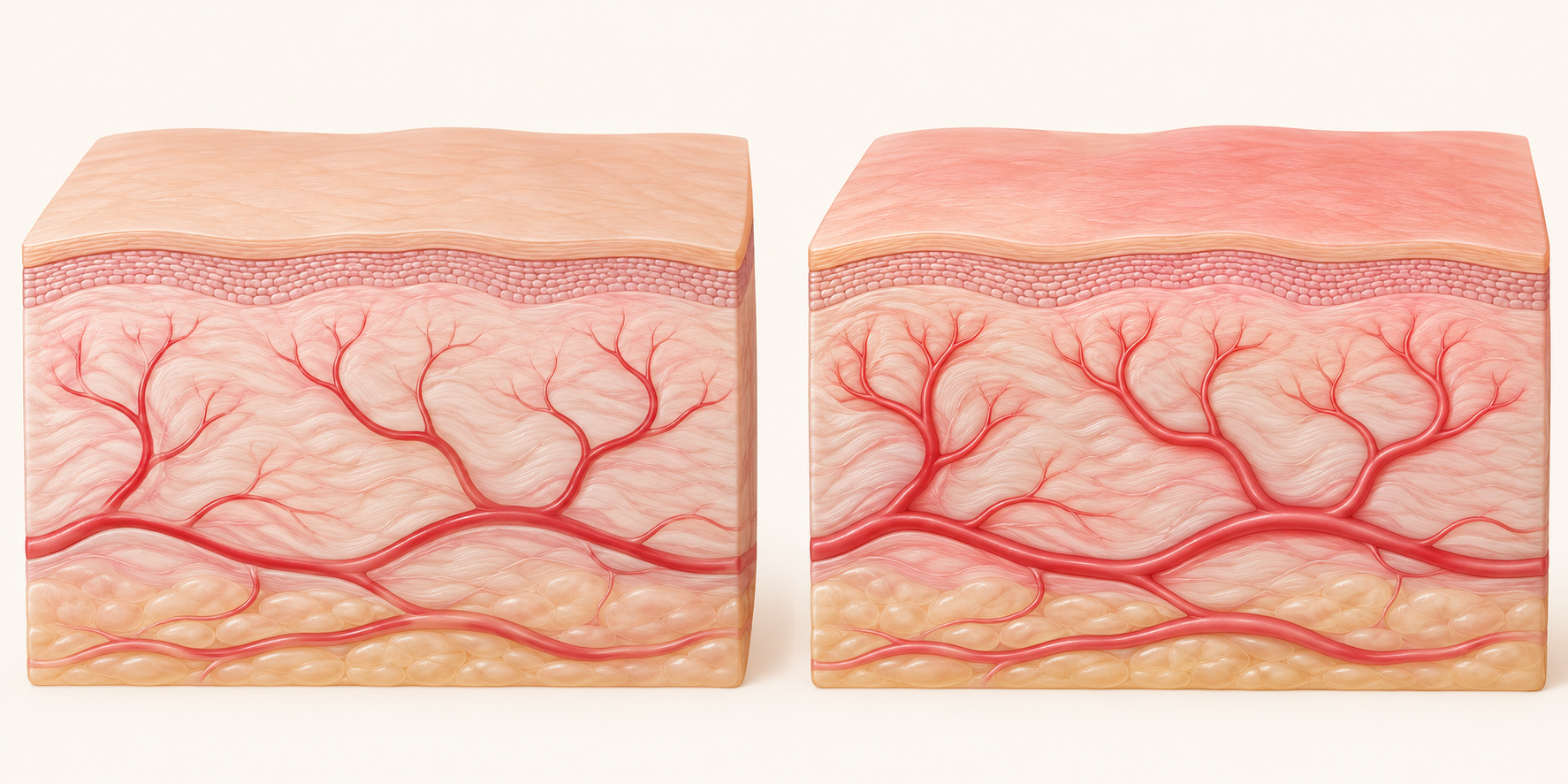
While nano and pico pigment toning target pigment with short pulses, what is commonly called Genesis uses the thermal effects of relatively longer, microsecond pulses to aim for improvements in skin texture and some redness.
A small study observed improvements in texture and redness, along with changes suggesting new collagen formation. But this does not mean it will work equally well for every type of redness or serve the same purpose as targeted treatment for dark spots. [Microsecond laser study]
This article discusses commonly performed 1064 nm nano and pico pigment toning, and microsecond 1064 nm Genesis. The 532 nm sun spot treatment mentioned earlier is an example of treatment for individual pigmented spots.
Why spots may remain after pico toning
What if the marks you want to fade are noticeable freckles or sun spots, but you have only been receiving toning intended to gradually reduce pigmentation across the whole face?
The change you wanted and the goal of the treatment may not have matched.
These spots may fade to some extent with toning. But that may not be enough to achieve the change you want, and treatment tailored to individual spots may be needed.
So, having spots left after pico toning does not automatically mean that picosecond lasers are ineffective. What was treated, and how, matters more than the word “pico.”
Of course, some people have a limited response even when the treatment target is appropriate. If there has been little change, I would first review the remaining pigmentation and the treatment already performed before adding more sessions.
Melasma needs care even after it improves
Melasma is a chronic pigmentary condition that can become darker again after improving. Alongside fading the visible brown patches, we need to manage that tendency to recur. [Expert consensus on melasma treatment]
Toning can help, but rather than simply increasing the number of laser sessions, it is important to also consider sun protection, skin barrier care and appropriate medication when needed.
One study found slower skin barrier recovery after irritation in skin affected by melasma. If your skin is dry or stings, moisturize adequately and reduce vigorous rubbing or excessive exfoliation. [Melasma skin barrier study]
Depending on your skin, the following treatments may also be considered:
- Melasma creams: Topical treatments help regulate processes such as pigment production. The ingredients and application method should suit your skin, with adjustments if irritation develops. [Expert consensus on melasma treatment]
- Oral medication: This is sometimes added depending on the severity of melasma and the response to treatment. The choice should be made with your clinician after reviewing your medical history and current medications. [Comparative study of oral melasma treatment]
- Skin boosters: A study found that certain ingredients used alongside laser treatment and oral medication helped improve melasma. However, the evidence varies by ingredient and treatment method. These are optional adjuncts to consider selectively according to your skin’s needs. [Study of combination treatment with a skin booster]
Moisturizing supports the skin barrier; melasma creams and oral medication help control pigmentation. These different roles can be combined in a plan suited to your skin.
Sun protection also needs to continue. For melasma, visible light as well as ultraviolet light may matter. In a study where both groups also used a topical melasma medication, protection against both UV and visible light produced better improvement. [Melasma photoprotection study]
The priority is to keep up the treatment and care your skin needs, rather than automatically adding more procedures.
At your next consultation, you could ask:
“What kind of spot is this that I want to fade? Is toning appropriate, or do I need targeted pigmentation treatment?”
- Before choosing a laser, find out whether the marks are melasma, freckles or solar lentigines. Several types can coexist on one face, so different spots may need different treatment plans.
- Toning gradually improves overall tone and scattered pigmentation. Noticeable individual freckles or sun spots may need targeted treatment. If little is changing, check the target and technique before adding sessions.
- Pico pulses have an advantage in concentrating energy in pigment and limiting heat spread. But they are not always better than nano for melasma improvement or pain, and post-treatment hyperpigmentation can still occur.
- Nano and pico mainly address pigment; Genesis aims to improve texture and some redness. The word “toning” does not mean all these treatments are the same.
- Melasma is a chronic pigmentary condition that needs ongoing care. Start with moisturizing, limiting irritation and sun protection, and consider appropriate creams or oral medication when needed. Skin boosters are optional adjuncts.
References
- Kim JY, et al. (2020). A Split-Face, Single-Blinded, Randomized Controlled Comparison of 532 nm Picosecond Neodymium-Doped Yttrium Aluminum Garnet Laser versus 532 nm Q-Switched Neodymium-Doped Yttrium Aluminum Garnet Laser in the Treatment of Solar Lentigines. Annals of Dermatology.
- Lee SY, et al. (2023). The Efficacy and Safety of a Low-Fluence 1064 nm Picosecond ND-YAG Laser Compared with Those of a Low-Fluence Photoacoustic Therapy Pulsed (PTP) Mode 1064 nm Q-Switched ND-YAG Laser for Treatment of Melasma: A Prospective Split-Face Study. Dermatologic Therapy.
- Omi T, et al. (2012). Low Fluence Q-Switched Nd:YAG Laser Toning and Q-Switched Ruby Laser in the Treatment of Melasma: A Comparative Split-Face Ultrastructural Study. Laser Therapy.
- Schmults CD, Phelps R, Goldberg DJ. (2004). Nonablative Facial Remodeling: Erythema Reduction and Histologic Evidence of New Collagen Formation Using a 300-Microsecond 1064-nm Nd:YAG Laser. Archives of Dermatology.
- Lee DJ, et al. (2012). Defective barrier function in melasma skin. Journal of the European Academy of Dermatology and Venereology.
- Ocampo-Candiani J, et al. (2025). Latin American consensus on the treatment of melasma. International Journal of Dermatology.
- Castanedo-Cazares JP, et al. (2014). Near-visible light and UV photoprotection in the treatment of melasma: a double-blind randomized trial. Photodermatology, Photoimmunology & Photomedicine.
- Shimojo Y, et al. (2023). Nonlinear absorption-based analysis of energy deposition in melanosomes for 532-nm short-pulsed laser skin treatment. Lasers in Surgery and Medicine.
- Feng J, Huang L. (2023). Comparison of Picosecond and Nanosecond Nd:YAG 1064-nm Lasers in the Treatment of Melasma: A Split-Face Randomized Clinical Trial. Plastic and Reconstructive Surgery.
- Kim YJ, et al. (2020). Clinical improvement of photoaging-associated facial hyperpigmentation in Korean skin with a picosecond 1064-nm neodymium-doped yttrium aluminum garnet laser. Lasers in Medical Science.
- Del Rosario E, et al. (2018). Randomized, placebo-controlled, double-blind study of oral tranexamic acid in the treatment of moderate-to-severe melasma. Journal of the American Academy of Dermatology.
- Bai JL. (2026). Hyaluronic acid-based skin booster with glutathione combined with 1064-nm Nd:YAG laser and oral tranexamic acid for melasma: A prospective comparative study. Medicine.
- Yang Y, et al. (2023). Comparison of the efficacy and safety of a picosecond frequency-doubled 532-nm Nd:YAG laser and a Q-switched frequency-doubled 532-nm Nd:YAG laser for the treatment of ephelides: A randomized, split-lesion, double-center, controlled trial. Journal of Cosmetic Dermatology.
- Vachiramon V, Iamsumang W, Triyangkulsri K. (2018). Q-switched double frequency Nd:YAG 532-nm nanosecond laser vs. double frequency Nd:YAG 532-nm picosecond laser for the treatment of solar lentigines in Asians. Lasers in Medical Science.
- Hong JK, et al. (2022). A prospective, split-face study comparing 1,064-nm picosecond Nd:YAG laser toning with 1,064-nm Q-switched Nd:YAG laser toning in the treatment of melasma. Journal of Dermatological Treatment.
- Yamamoto H, et al. (2025). Deep Learning-Based Classification System for Facial Pigmented Lesions to Aid Laser Treatment Decisions. Cureus.
- Bastiaens M, et al. (2001). The melanocortin-1-receptor gene is the major freckle gene. Human Molecular Genetics.
- Sarkar R, et al. (2025). Efficacy and safety of Q-switched neodymium-doped yttrium aluminum garnet (532 nm) in freckles in skin of color patients. Journal of Cutaneous and Aesthetic Surgery.
- Adalatkhah H, et al. (2008). Melasma and its association with different types of nevi in women: A case-control study. BMC Dermatology.




Leave a Reply