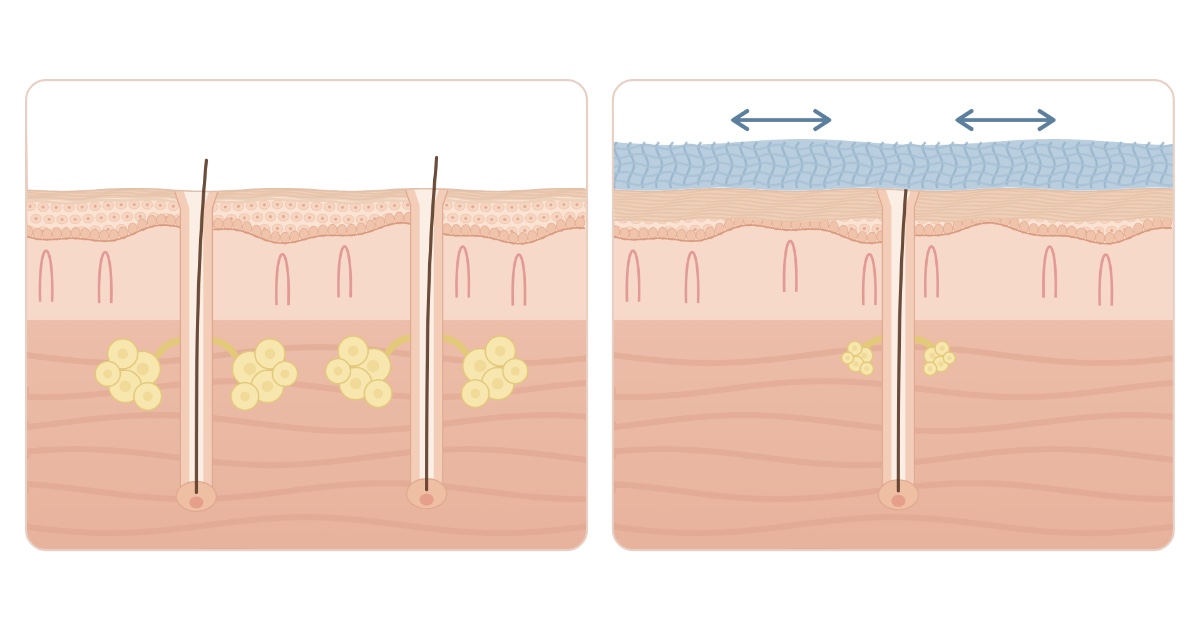
By Daebbang
“My facial acne has gotten a bit better, but I keep breaking out on my back and chest. Can I just treat it the same way as my face?”
The short answer: back and chest acne is the same condition as facial acne, but it is managed quite differently. The skin on the trunk has a thicker outer layer than facial skin and is more exposed to sweat and to friction and occlusion from clothing. As a result, inflammation tends to form deeper. Topical medicines penetrate less well, and scars and dark marks also tend to last longer[1, 2].
There is one more thing. Not every bump on the back and chest is acne. If the bumps are itchy and spread out at a similar size, they may be folliculitis caused by yeast, and the treatment approach is completely different[1, 3].
In this article, I will go over how body acne differs from facial acne, what you can do at home and how treatment differs, and when you should see a doctor.
How common is back and chest acne?
More common than you might think. In a review that pooled several surveys, about 30–60% of people with facial acne also had acne on the body. Acne on the body alone was rare[4]. A Korean consensus report by dermatology experts (funded by the pharmaceutical company Galderma) also considers that more than half of acne patients have acne on the chest, back, or shoulders[3].
Yet it is treated less often. In a Korean study that surveyed 211 first-year high school students in Incheon, 47.4% of students said they had body acne, but only 17.6% had received treatment for body acne, much lower than for facial acne (48.6%)[5]. Because it is hidden under clothing, it is easy to put off.
Research on body acne itself has also been scarce for a long time. Until now, treatments developed for facial acne have largely just been carried over to the body, and experts point out that international guidelines should also reflect body acne more fully[6].
Why does the same acne behave differently on the body?
The basic mechanism of acne is the same. Pores become blocked with sebum and dead skin cells, and inflammation develops inside them. However, trunk skin has a different foundation from facial skin.
- The outer layer (stratum corneum) is thicker. Topical medicines may penetrate the skin less well[2].
- There are far fewer sebaceous glands than on the face[2]. Instead, trunk skin is more vulnerable to external factors such as sweat, pressure, friction, and occlusion[1].
- It is always covered by clothing. When the hot, humid environment under clothing lasts a long time, inflammation can get worse. Acne triggered by tight clothing or repeated friction or pressure is specifically called “acne mechanica”[2]. The Korean expert consensus report also considers that body acne is more affected by sweat than facial acne and has more inflammatory lesions because of the clothing-covered environment[3].

These differences carry straight over into care. When the outer layer is thick, topical medicines may penetrate less well, and when friction and occlusion continue, acne tends to come back even with medication. Body acne tends to respond to treatment more slowly than facial acne[1].
For reference, the review cited above that details the structure and care of trunk skin[2] was written by authors affiliated with a skin-related company research institute. The authors stated that they had no funding and no conflicts of interest.
Scars and marks are a bigger worry with body acne
Most body acne is inflammatory acne that becomes red and swollen. Scars readily form on the shoulders and upper chest, and the dark marks left where acne has healed (post-inflammatory hyperpigmentation) also tend to be more common and longer-lasting than on the face[2]. In a study cited by one review, among 696 acne patients aged 14–20, 10.6% of those with body acne had scars on the body[1].
The type of scar may also differ. In the Korean expert consensus report, 77.8% agreed that hypertrophic scars or keloids, where raised tissue forms where inflammation has healed, develop more readily on the body than on the face[3]. There is also an expert panel opinion that people who already have scars on the body are at higher risk of developing more scars (the pharmaceutical company paid panel members honoraria for participating)[7]. For this reason, experts recommend treating body acne early rather than putting it off[1, 3].

Why marks form and how long they last is covered in detail in Dark Patches After Laser Treatment: Why Does Post-Inflammatory Hyperpigmentation Happen, and How Long Does It Last?.
Itchy bumps of similar size may not be acne
The condition most easily confused with back and chest acne is Malassezia folliculitis. It is a folliculitis in which a yeast that normally lives in hair follicles (Malassezia) causes itchy bumps and pustules[8]. It is the condition most often misdiagnosed as body acne[1], and the Korean expert consensus report also lists it as a condition that must be distinguished from body acne[3].
Clues that help tell it apart from acne are as follows[1].
- Small red bumps and pustules of similar size are spread over the upper chest and back, neck, and upper arms.
- They itch.
- No comedones such as blackheads or whiteheads are visible.
- They do not improve with the antibiotics used for acne.
Hot, humid weather and clothing are cited as aggravating factors[9]. Because it is hard to be sure from appearance alone, it is diagnosed with a test in which a sample is taken from the skin surface and the yeast is identified under a microscope[2, 9]. A European expert position statement also recommends confirming the cause before starting the appropriate treatment[8].

The difference between acne and folliculitis is explained in more detail in Acne or Folliculitis? How Can You Tell Similar-Looking Bumps Apart?.
How does treatment differ from facial acne?
The types of medicine used are not very different from those for facial acne. The American Academy of Dermatology guideline strongly recommends benzoyl peroxide, topical retinoids, topical antibiotics, and oral doxycycline for acne treatment[10]. The difference lies in how they are used over the large area of the trunk.
Topical medicines. On large, hard-to-reach areas like the back, applying medicine consistently every day is difficult. Experts also consider that when prescribing topical medicines for the body, ways to reduce the inconvenience of application should be considered as well[7]. That is why benzoyl peroxide is often used as a wash applied in the shower and rinsed off after a short time, or as a foam formulation[1, 2]. Benzoyl peroxide has a bleaching effect, so be aware in advance that using it over a large area can fade the color of clothing, towels, and bedding[2].
Oral medicines. In the Korean expert consensus report, 94.4% agreed that moderate or more severe body acne is difficult to control with topical medicines alone, so oral antibiotics or isotretinoin are prioritized[3]. Because oral antibiotics can lead to resistant bacteria, they are used for as short a time as possible, about 3–4 months[1]. Isotretinoin is strongly recommended for severe or scarring acne and for acne that has not responded to previous treatment[10]. In women, oral medicines that regulate hormonal effects (oral contraceptives, spironolactone) are also options that the guideline conditionally recommends[10]. In a study that looked back at 403 women who used spironolactone, acne had decreased or cleared on the chest in 84.0% and on the back in 80.2% at the first follow-up visit[11]. However, because it was a single-center review of records without a comparison group, its effect on body acne needs further confirmation[2, 11].
Waiting time. Body acne tends to respond to medicine more slowly than facial acne[1]. Rather than switching or stopping a medicine because you do not see results right away, it is better to use it consistently for the prescribed period and check the response together at your appointments.
What you can do in daily life
The evidence for lifestyle measures is weaker than for medicines. Still, because body acne is affected by friction and occlusion, I recommend starting with things that are easy to try.
- Wear loose, breathable cotton clothing, and after exercise, wash off the sweat and change your clothes. There are studies suggesting this may help. However, in a small pilot study that varied the timing of showering after exercise (7–8 people per group), there was no difference in acne development[2].
- Do not wash your back with hot water for a long time or scrub it hard[2]. Scrubbing as if exfoliating actually adds friction irritation.
- Do not squeeze hard-to-reach back acne using a mirror. Why you should not squeeze at home is covered in Should You Pop Pimples? When Squeezing at Home Is Risky, and How Clinic Extraction Differs.
When to see a doctor
Body acne is easy to put off, but 91.7% of the experts on the Korean consensus panel agreed that treating it early can raise the chance of treatment success[3]. In particular, see a doctor in the following situations.
- When scars or dark marks start to remain: There is an expert opinion that if you already have scars, you are at higher risk of developing more scars[7]. Scarring acne is also a criterion for considering oral medicines[10].
- When it is deep, painful, or widespread: Most experts on the Korean consensus panel consider that moderate or more severe body acne is difficult to control with topical medicines alone[3].
- When it keeps coming back despite consistent care and topical medicines: Acne that has not responded to previous treatment warrants considering other treatments[10].
- When itchy bumps of similar size are spread out and no comedones are visible: It may be Malassezia folliculitis rather than acne. Confirming the cause with a test comes first[1, 8].
Take-home messages
- Back and chest acne is the same condition as facial acne, but it is managed differently because of the characteristics of trunk skin.
- About 30–60% of people with facial acne also have acne on the body. Because it is hidden under clothing, treatment is easy to put off.
- Trunk skin has a thicker outer layer and is strongly affected by sweat, friction, and occlusion from clothing. As a result, inflammation tends to be deeper and to respond to medicine more slowly.
- Body acne tends to leave scars and dark marks that last a long time. If scars start to form, do not put it off; see a doctor.
- If itchy bumps of similar size have no comedones, it may be Malassezia folliculitis. The treatment is different, so confirm the cause first.
- For large areas, a benzoyl peroxide wash that is rinsed off is often used. It can fade the color of clothing and towels.
- For moderate or more severe acne, oral medicines are often used together. Results may appear more slowly than on the face, so keep using them for the prescribed period.
- Loose cotton clothing, washing and changing after exercise, and not scrubbing hard are easy measures worth trying.
References
[1] Woo YR, Kim HS. Truncal Acne: An Overview. Journal of Clinical Medicine. 2022;11(13):3660. DOI: 10.3390/jcm11133660
[2] Feng X, Chen Y, Liu Y. Truncal Acne: Pathophysiology, Clinical Features, and Management Strategies. Journal of Cosmetic Dermatology. 2026;25(2):e70715. DOI: 10.1111/jocd.70715 (Author affiliation: company research institute)
[3] Ko JY, Song CH, Kim KJ, et al. Consensus Report on Truncal Acne: The Korean Acne and Rosacea Society Experts Panel. Annals of Dermatology. 2024;36(1):35–43. DOI: 10.5021/ad.23.057 (Funded by the pharmaceutical company Galderma)
[4] Tan J, Del Rosso JQ, Weiss JS, et al. Prevalence and Demographics of Truncal Involvement Among Acne Patients: Survey Data and a Review of the Literature. Journal of Clinical and Aesthetic Dermatology. 2022;15(10):62–67. PubMed: 36312821 (One author is affiliated with the pharmaceutical company Galderma)
[5] Lee YB, Cho M, Kim HS. Beyond the Face: An Exploratory Survey on Facial and Truncal Acne in High School Students. Annals of Dermatology. 2026;38(2):89–97. DOI: 10.5021/ad.25.135
[6] Leccia MT, Claudel JP, Ballanger F, Auffret N, Dreno B. Four years of study by an expert group on truncal acne: where are we now? European Journal of Dermatology. 2025;35(1):25–30. DOI: 10.1684/ejd.2025.4809
[7] Tan J, Alexis A, Baldwin H, et al. Gaps and recommendations for clinical management of truncal acne from the Personalising Acne: Consensus of Experts panel. JAAD International. 2021;5:33–40. DOI: 10.1016/j.jdin.2021.06.007 (The pharmaceutical company Galderma paid panel members honoraria)
[8] Henning MAS, Hay R, Rodriguez-Cerdeira C, et al. Position statement: Recommendations on the diagnosis and treatment of Malassezia folliculitis. Journal of the European Academy of Dermatology and Venereology. 2023;37(7):1268–1275. DOI: 10.1111/jdv.18982
[9] Vlachos C, Henning MAS, Gaitanis G, Faergemann J, Saunte DM. Critical synthesis of available data in Malassezia folliculitis and a systematic review of treatments. Journal of the European Academy of Dermatology and Venereology. 2020;34(8):1672–1683. DOI: 10.1111/jdv.16253
[10] Reynolds RV, Yeung H, Cheng CE, et al. Guidelines of care for the management of acne vulgaris. Journal of the American Academy of Dermatology. 2024;90(5):1006.e1–1006.e30. DOI: 10.1016/j.jaad.2023.12.017
[11] Garg V, Choi JK, James WD, Barbieri JS. Long-term use of spironolactone for acne in women: A case series of 403 patients. Journal of the American Academy of Dermatology. 2021;84(5):1348–1355. DOI: 10.1016/j.jaad.2020.12.071


Leave a Reply